2025 Reading Favorites

This year marks the tenth anniversary of “Reading Favorites.” (That sounds so much more fancy and official than it really is. But it’s nonetheless true.) I started this online tradition of posting an annual roundup of my favorite books after reading Tony Reinke’s Lit! A Christian Guide to Reading Books in 2015. Reinke’s book, along with Tim Challies’ “Reading Challenge,” inspired me to invest more heavily in the discipline of reading, both for the delight of it (because our God is a God of life-begetting words) and to swim against the heavy cultural current of what journalist Nicolas Carr has coined “the shallows.”
I truly have been so delighted by this investment.
This was a heavy writing year for me. (Sarah Walton and I finished our second co-written book titled Jesus Will Meet You There, releasing July 2026.) For that reason, I expected my reading intake to significantly drop, but it stayed steady. When I have felt discouraged by a “lighter” reading year, I remember: (a) Christ is my righteousness, not the number of books I read; and (b) creative output takes resources that are worth the expenditure, even when input is less and must be tabled for another season.
Here are my primary reading principles:
- I set a reading goal for the year and divide it up into quarters so it seems attainable. (For example, if I aim to read 20 books, then that means I need to finish five books in the next three months.)
- I read every day for at least 15 minutes (and usually for 30 minutes) during the kids’ rest time and/or after their bedtime.
- I take reading material with me or use audio books (instead of browsing my phone—believe me, not a perfect science!).
- I read books I’m interested in and want to read. I also love asking around for recommendations.
- I vary and cycle the genres to keep things fresh.
Following is my annual roundup of favorite books from 2025. This doesn’t mean they were published this year, nor does it mean I agree with everything I read; instead, this list of favorite books follows the criteria I first used in 2015’s Reading Favorites article:
If one of the main purposes of books is to make the reader think, then these are the ones I’d say made me think most deeply, curiously, and enthusiastically this year. I’ve chosen a first prize and a runner-up for each genre.
Happy reading and happy new year, friends!
Theology
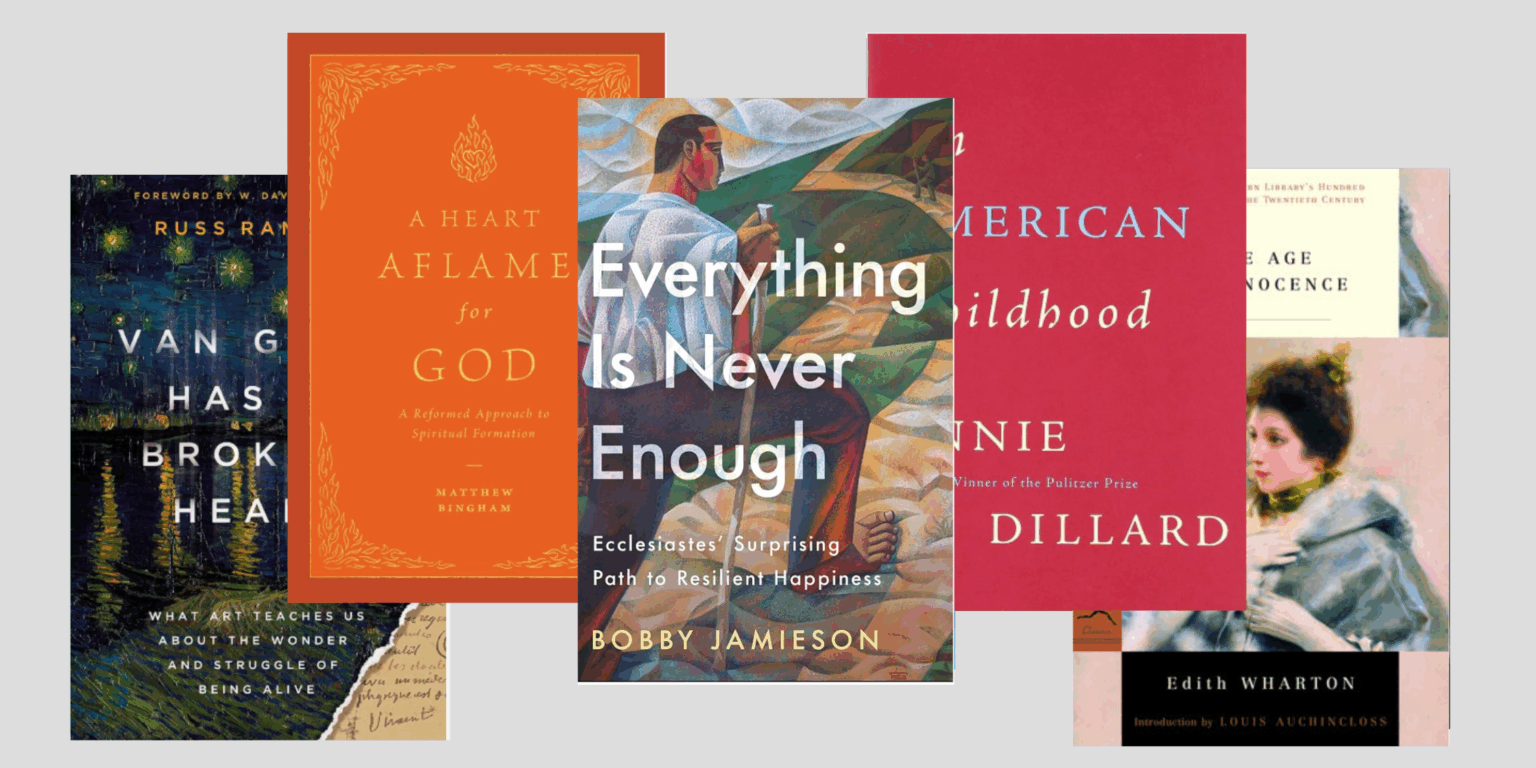
First Prize: Everything Is Never Enough: Ecclesiastes’ Surprising Path to Resilient Happiness (Bobby Jamieson)
There are a few books I can’t stop talking about and recommending to others, and this is one of them. I’m impressed by the depth and clarity with which pastor Bobby Jamieson tackles such an enigmatic book of the Bible. This title came to me at just the right time, in a season of many cancer diagnoses and grapplings with death. It was just what I needed. Don’t miss reading it next year.
Runner-Up: Expository Thoughts on the Gospels (J. C. Ryle)
As I mentioned, Sarah Walton and I spent a lot of this past year writing about Jesus in the Gospels, and Ryle’s seven-volume commentary series proved invaluable. Ryle’s thoughts are warm and pastoral, full of grace and truth. This is an accessible set that would benefit any Bible reader, not just teachers.
Biography, Memoir, Culture, and Historical Fiction
First Prize: An American Childhood (Annie Dillard)
Annie Dillard’s memoir about her growing up years in Pittsburg was my first foray into her books, and now I see why people love her. She and I don’t think in the same ways, which made her writing hard for me to follow at times—but I also grew envious of her mind. From her childhood, she was a blossoming creative, someone who could not help but see the significance in everything. I wish I was more like that.
Runner-Up: The Deep Places: A Memoir of Illness and Discovery (Ross Douthat)
In 2014, right after Brad and I got married, I was diagnosed with chronic Lyme disease. Boy, was that a road. I’d been wanting to read Douthat’s account since it released in 2021, and so much of it resonated with me. It felt like Douthat knew what I had experienced in full (which people rarely do). In his poignant and honest tell-all, this very sick husband, journalist, and dad of three shares about his Lyme journey, which is ongoing, and raises important awareness for readers.
Christian Living
First Prize: A Heart Aflame for God: A Reformed Approach to Spiritual Formation (Matthew Bingham)
Sometimes a book sings your heart’s song. A Heart Aflame for God felt like my kindred-spirit book, written in tune with my deepest convictions and longings about God’s word and spiritual growth. Bingham surveys a history of Reformed pastors and writers to answer the question, “How does a Christian actually grow?” I appreciate his thoughtfulness to combat trite answers while keeping first things first (Scripture, meditation, prayer) while delving deeply into some matters of confusion and controversy (the role of the body and the importance of the local church). I love this book!
Runner-Up: Memorizing Scripture: The Basics, Blessings, and Benefits of Meditating on God’s Word (Glenna Marshall)
It’s not hard to love everything Glenna Marshall writes. (And I’m honored to call her my friend.) But her book on Scripture memorization surprised me. I don’t think I was prepared to be that easily convinced—a testament to her persuasive writing, yes, and also a confession of how little I’ve believed it mattered. So I went for it: I taped Ephesians chapters 1–3 in my shower. And friends, I memorized all of it. If I can do it, you can do it. Let Marshall’s book be your guide!
Vocation & Learning
First Prize: Van Gogh Has a Broken Heart: What Art Teaches Us About the Wonder and Struggle of Being Alive (Russ Ramsey)
Russ Ramsey has blessed us with another fantastic and thoughtful art book. I am not one to give my time and attention to visual art like Ramsey does, but I would like to be more like him in the future. A person who can evoke appreciation and longing through their own love for something is doing that “something” right. Certain chapters in his book brought me to tears. This one’s worth your time.
Runner-Up: Family Driven Faith: Doing What It Takes to Raise Sons and Daughters Who walk with God (Voddie Baucham)
Voddie Baucham, our dear brother in Christ, went home to be with his Lord this year. While some of Baucham’s convictions in Family Driven Faith come across too strongly (rather than being considered areas of Christian freedom), I appreciate his boldness in communicating his message. Family worship was a huge theme for our home this year, and his book cut through the fluff and got to the point. It was practically helpful, thought-provoking, and inspiring.
Fiction
First Prize: The Age of Innocence (Edith Wharton)
A story of family honor, marriage vows, personal ambition, and temptation’s snare, The Age of Innocence chronicles a complex love story in New York City’s high society in the late 1800s. In our age when anything goes and “love” is based on taste and preference rather than covenantal commitment, this Pulitzer Prize-winning tale of star-crossed lovers refreshed my spirit.
Runner-Up: Theo of Golden (Allen Levi)
Whenever a new author arrives on the scene and makes a huge splash, one must wonder why and how. Allen Levi’s story about the mysterious advent of elderly Theo in a little known town, and his impact on the townsfolk, warmed my heart. Some have criticized the book for being overly saccharine and idyllic, even preachy, but its point stands as one worth making: one person can make a huge difference, especially when that person seeks to bless others.

Kristen Wetherell
Kristen Wetherell is a wife, mother, and writer. She is the author of multiple books including Humble Moms, Fight Your Fears, Help for the Hungry Soul, and the board book series For the Bible Tells Me So, and the co-author of the award-winning book Hope When It Hurts.